
It's Not the Destination, It's the Journey
Originally published March 22, 2022.
In 1962, historian Daniel Boorstin published The Image: A Guide to Pseudo-Events in America. I read it in college in the late 1980s, and it has informed how I think about authenticity and communication ever since. Boorstin observed how politicians were engineering events for the media to amplify — constructing narratives rather than simply living them. He was describing influencers decades before the word existed. His central warning, the one that has stayed with me through a career in marketing, research, and communications, is simple: there must be authenticity in any message you put in front of an audience. Don't waste their time.
That principle shaped how I approached photography when I began to take it more seriously. Rather than simply posting work, I developed a deliberate strategy — entering local competitions, sending press releases when I placed, building awareness the way I would for any project I believed in. The work had to come first, but the story around it mattered too.
In the winter of 2020, Delaware Beach Life magazine reached out to ask if I'd be interested in a profile. The publisher had been following my photography and felt it was worth sharing with their readers. I said yes immediately — though what followed turned out to be harder than I expected.
The magazine assigned award-winning writer Chris Beakey to interview me. We met in person, had multiple calls, and worked to make the profile as honest as possible. I went in thinking I knew what I wanted to say. But Chris pushed me to go deeper — to think seriously about my creative journey, my ideas about art, and why any of it matters. For someone who has spent most of his career telling other people's stories, being on the other side of that conversation was genuinely uncomfortable. I'm grateful for it. Chris guided me toward something more real than I would have found on my own.
The magazine also assigned photographer Pam Aquilani to make an environmental portrait. When she mentioned wanting to photograph me doing my "landscape photography," I paused — I didn't think of myself as a landscape photographer. But one image in particular had caught the magazine's attention: Summer Breeze on Whites Creek. Looking at it again, I understood why. The image has a quality I'm drawn to across all of my work — it shows just enough to suggest a scene while leaving room for the viewer to enter it. The grasses and tree move in the summer wind, and the feeling of being in those elements comes through without the image spelling it out.
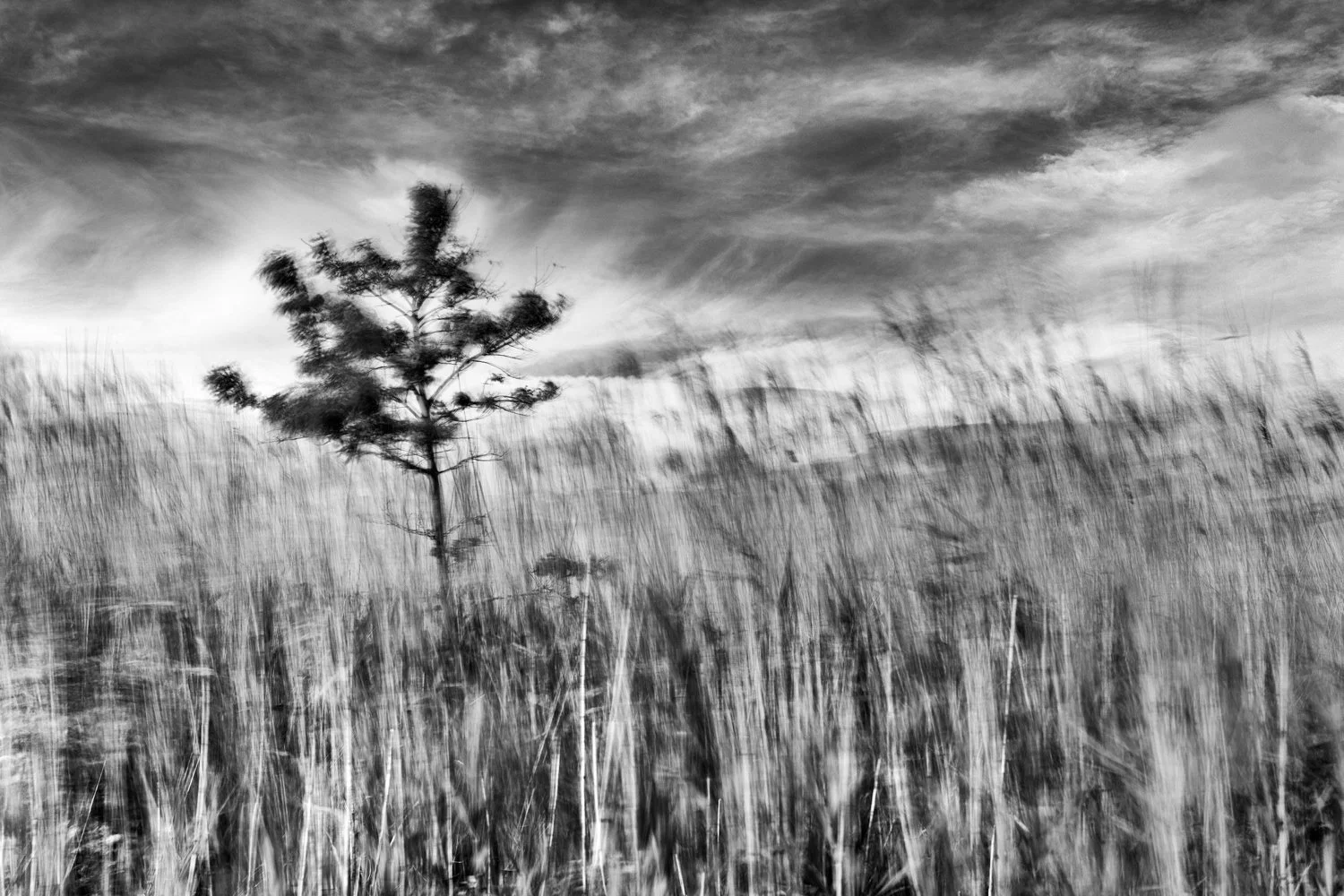
Summer Breeze on Whites Creek, Ocean View, DE — 2016
That conversation became a prompt. When the Rehoboth Art League issued a call for an October 2021 show on the theme of Abstract Landscape, I saw a challenge I wanted to take on. Rather than photograph a landscape, I wanted to distill one — to show only the effects of its essential elements. Sun. Water. Sand. I spent weeks testing materials and methods. I used a magnifying glass to burn paper, capturing the heat of direct sunlight. I boiled and manipulated paper to suggest the restless energy of the ocean. I made small cyanotypes to preserve the imprint of sand on a surface. The resulting triptych, Coastal Imprint(s), was accepted into the show.
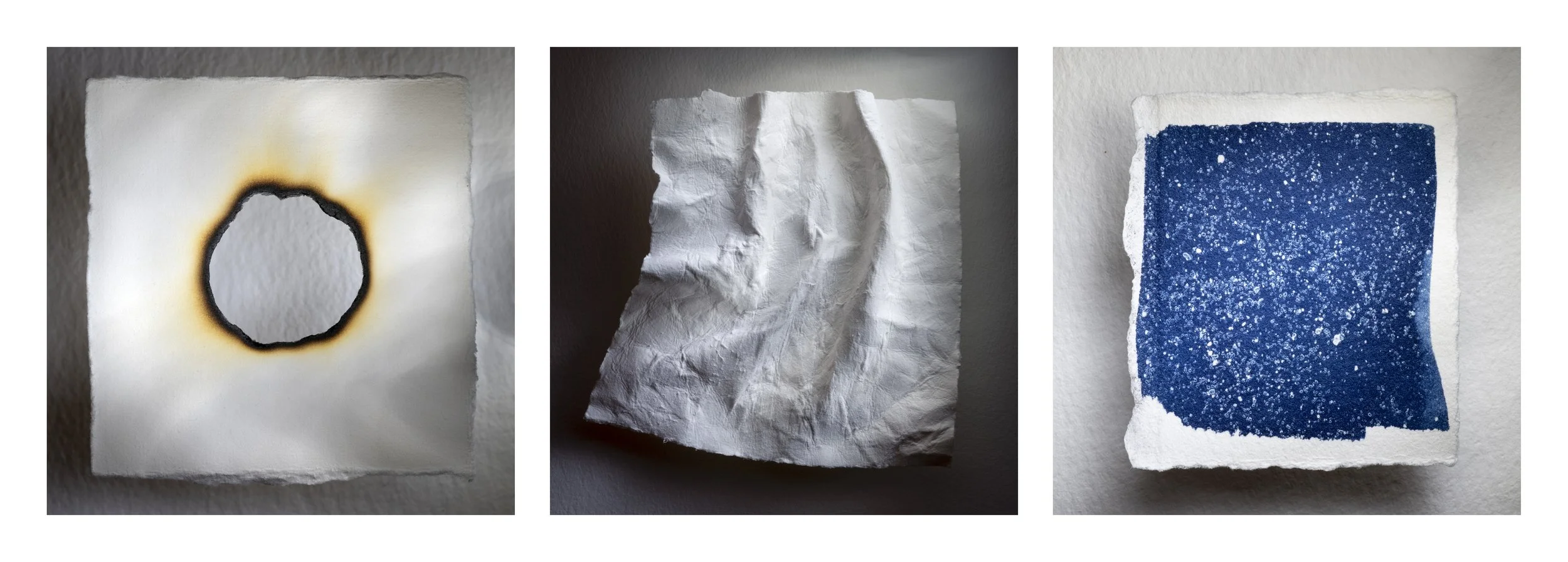
Coastal Imprints, Ocean View, DE — 2021
Looking back, that piece was a turning point — a moment where I moved from photographing the world to building a process that could enact an idea. That instinct has only deepened since. The work I've made in the years that followed begins with a question or a condition in the world and builds toward it through repetition, material, and accumulated gesture. The goal, as I think about it now, is to move a viewer past the surface of an image toward feeling and ideas. Ambiguity isn't a flaw in that kind of work. It's an invitation — space for each person to bring their own meaning.
None of that trajectory was visible to me in 2020 when I first said yes to a magazine profile. The Delaware Beach Life story led to an invitation from the Rehoboth Beach Writers Guild's Art in the AM program. That led to new conversations and new questions about the work. Each step prepared me for the next one, without my being able to see where any of it was going.
Which brings me back to Boorstin — and to a reminder I keep returning to: worry less about managing the message, and stay focused on the authenticity of the experience. Ralph Waldo Emerson put it better than I can: "To finish the moment, to find the journey's end in every step of the road, to live the greatest number of good hours, is wisdom." Or as it's been simplified over time: it's not the destination, it's the journey.