
The Crucible
On pain, persistence, and where the work is going
My grandfather, a hobbyist, studied the portraiture of Yousuf Karsh. My mother has a natural eye. I spent decades training, then building a career watching technology reshape how images are made and what they mean. By that account, photography was always the thread.
But that version leaves out the crucible.
For a decade, chronic pain was the dominant fact of my life. It dismantled things quietly and then all at once — my ability to concentrate, to write, to work, to think. For someone with a highly analytic mind, that particular loss was its own cruelty. The fog didn’t lift on command. It settled in and stayed a long time.
What survived, barely at first, was seeing. I picked up an iPhone. Then a professional camera and a macro lens. Then a focusing rail designed for scientific microscopy — the kind used in research labs. I started making images of a crumpled piece of metal salvaged from a demolished bridge, of bell peppers, of maple leaves, of Codd-Neck bottles from the 1870s. None of it was grand. All of it mattered enormously. The act of looking closely at something — really closely, to the point where a leaf becomes a landscape and a pepper becomes a form of sculpture — created a stillness that pain couldn’t fully reach. I called it mindful focus. It turned out to be more than a coping mechanism. It was a practice, and eventually, a body of work.
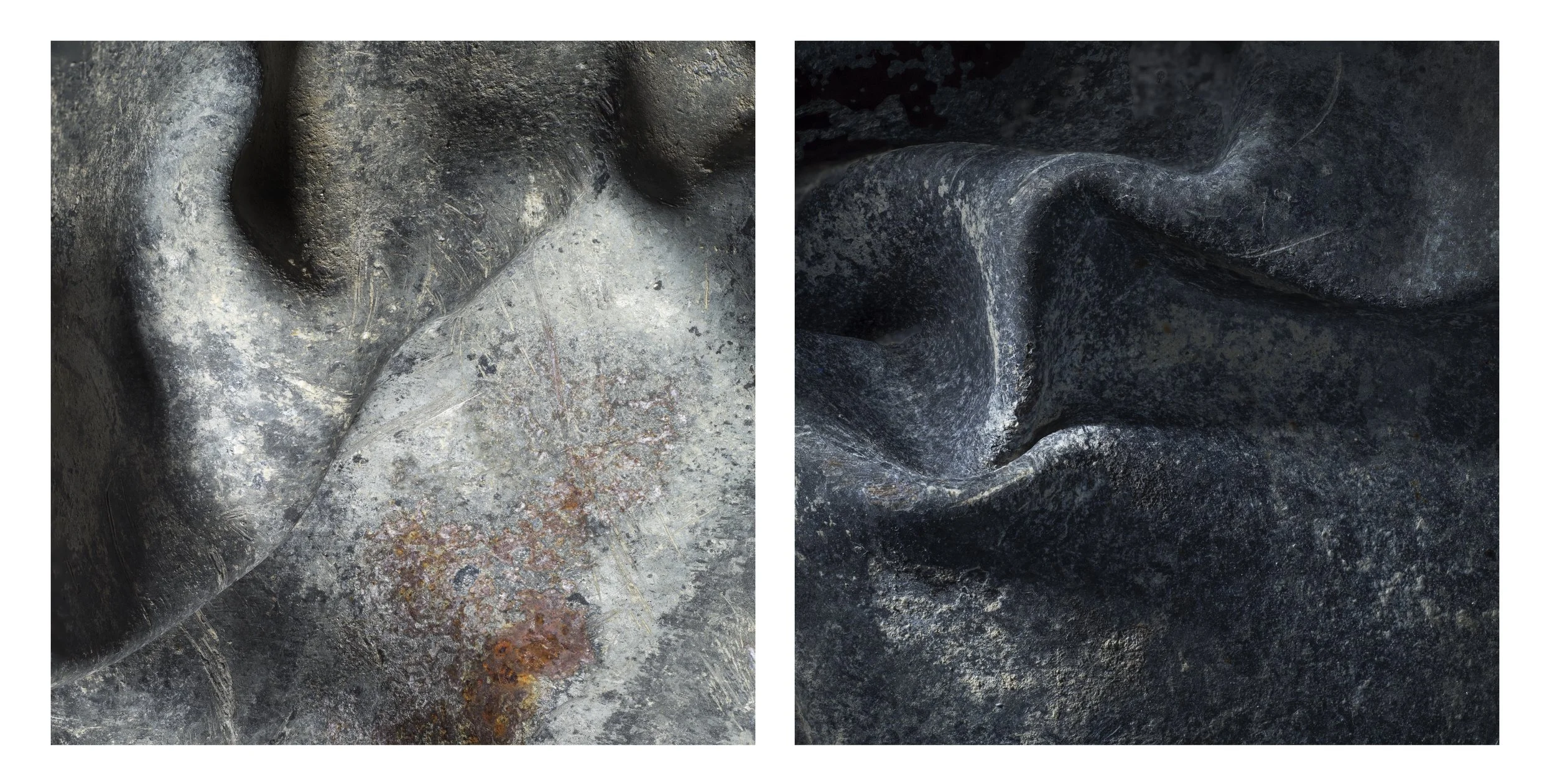
Relic of the 1965 Cullen Bridge (Views 1 & 2), Ocean View, DE — 2015
What I didn’t fully understand at the time was that the crucible was doing more than helping me survive. It was clarifying something. When you’re forced to find meaning in what’s immediate and overlooked, you stop making pictures for approval. You start making them because the act of seeing is itself the thing. That shift — from image-making as craft to image-making as inquiry — changed everything.
The work that followed became more interested in questions than answers. What is the nature of a thing? What makes it worth looking at? What happens when you look long enough that the subject stops being what you thought it was?
Those questions lived in the formal work — the abstractions, the close studies of form and texture and light. But somewhere around 2019, something shifted. I was watching the impeachment hearings, listening to the same words repeated until repetition itself seemed to alter their meaning. I sat down with a 1930s Royal 10 typewriter and started typing the words fact and fake, over and over, correcting with white-out, layering them until the difference between the two became genuinely hard to see. Fact Fake wasn’t really a political statement. It was more like a record of a psychological condition — what it feels like to watch meaning erode in real time.
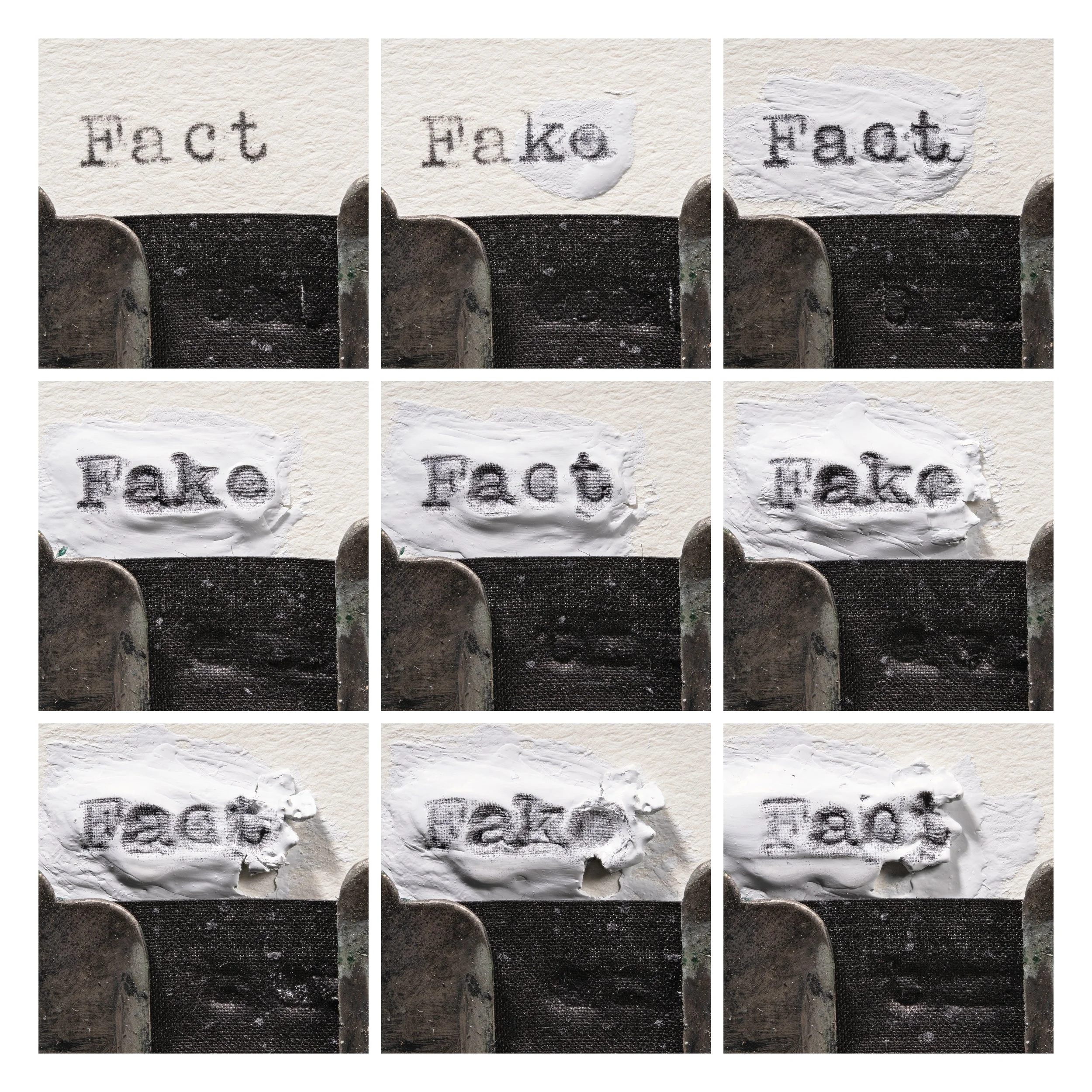
Fact Fake, Ocean View, DE — 2019
That piece opened a door I haven’t closed since.
The recent work lives in that same territory, but the materials have changed. While I still use photography to document and present the work — the technical rigor hasn’t gone anywhere — I now reach for cyanotype, graphite, wax, Polaroid, and broken glass. These are processes that leave traces. They record what happened to them. You can’t retouch them into something they’re not.
Erasure is graphite applied and removed, repeatedly, until the paper itself bears the evidence of the struggle. The Cost of Lies is mechanically printed text, carved into and corrected until the word lies is never quite gone. Broken uses cyanotype to capture the memory of shattered glass — not the glass itself, but the light that passed through it. The fragments don’t reassemble. That’s the point.
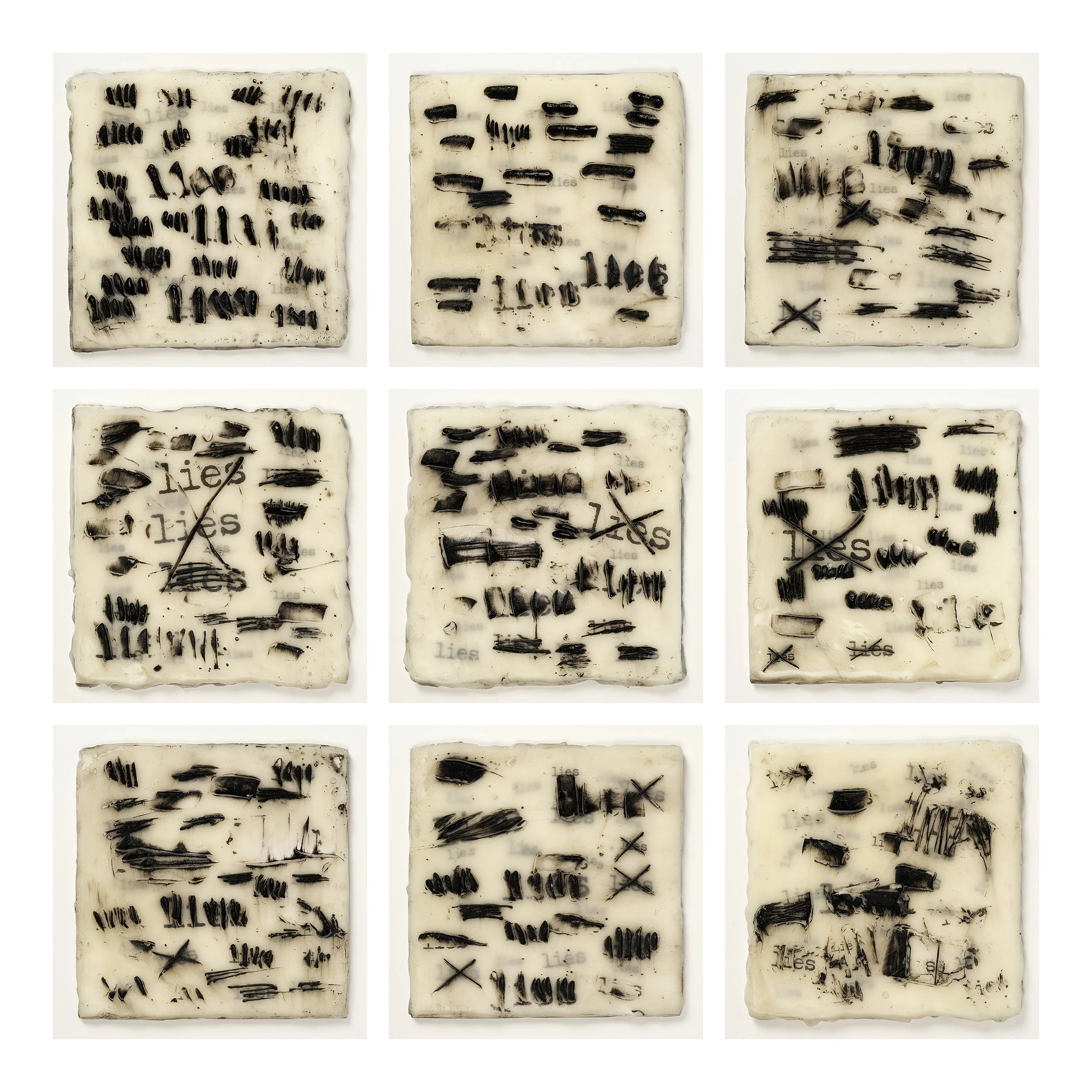
The Cost of Lies, Ocean View, DE — 2026
There’s something in all of this that connects back to the crucible. Pain taught me that some things don’t return to their prior form — that the damage and the healing are both part of what you become. The current work is asking the same of its materials, and by extension, of the moment we’re in. What remains when something breaks? What persists after an attempt at erasure? What does a lie look like when you watch it accumulate?
I don’t make this work to answer those questions. I make it to hold them open long enough for a viewer to enter and bring their own experience to bear.
That openness, I’ve come to understand, was itself learned.
I’m not sure I could have made any of this without the years of looking closely at small, overlooked things. The bell peppers and the Codd-Neck bottles weren’t detours. They were training — in patience, in attention, in the discipline of stripping away everything except what matters. That practice is still in everything I make, even when the subject has shifted from a leaf to a political crisis.
The work is heading somewhere I can’t fully see yet. What I know is that it asks harder questions than it used to, uses materials that resist easy resolution, and keeps returning to the question of what survives — what light passes through, what residue remains, what a break looks like when you examine it without looking away.
That feels like the right direction. The crucible taught me not to flinch.