
The Reverence Never Left
Photography, Printmaking, and the Search for Authenticity
I’m starting to realize my age when I think about the waves of technology change I’ve witnessed in the graphic arts industry. Digitization infiltrated and disrupted every aspect of the craft — first from within, then from the outside — and the pace of innovation and disruption is only accelerating.
Honestly, it makes me nostalgic for how things were before we went digital. My formal education began in the late 1980s at the Rochester Institute of Technology (RIT), at perhaps the peak of analog processes in both photography and print. RIT was at the epicenter of the industry, in a town where imaging was in the DNA (and probably the water). Our professors wrote the books on imaging science, materials and processes. It was a privilege to study under the watchful eye of Leslie Stroebel and Richard Zakia amongst many other great teachers. 4-quadrant tone reproduction curves were drilled into us … the Jones Diagram. We learned to revere materials and the process. But it was always a means to an end.
Film was central to everything we did. Film in all its sizes and formulations felt like a record of life itself — as if alchemists had miniaturized the real world onto gelatin. That magic was something to behold. I still remember the countless hours spent in the darkroom making prints: black and white fiber, RA-4, Cibachrome, and dye transfer. The creation of the print felt part magic, part ritual, part sacred. We produced work intended to be kept and cherished.
On the commercial print side, high-end drum scanning was already a mature technology. The controls on the Hell and Crosfield scanners gave operators tremendous ability to reproduce a film image with deference to the photographer's intention. The film strippers and dot etchers — highly skilled workers who had once made color separations largely by hand and corrected dot values with chemicals and paint — were part of an industry finely tuned to elevate the image. The scanners automated much of that separation work, but dot etchers remained essential for correcting what the scanner missed: a face too red, a sky too flat, a color that had to match a client's expectation exactly. In today's dollars, those scanners would cost around a million dollars.
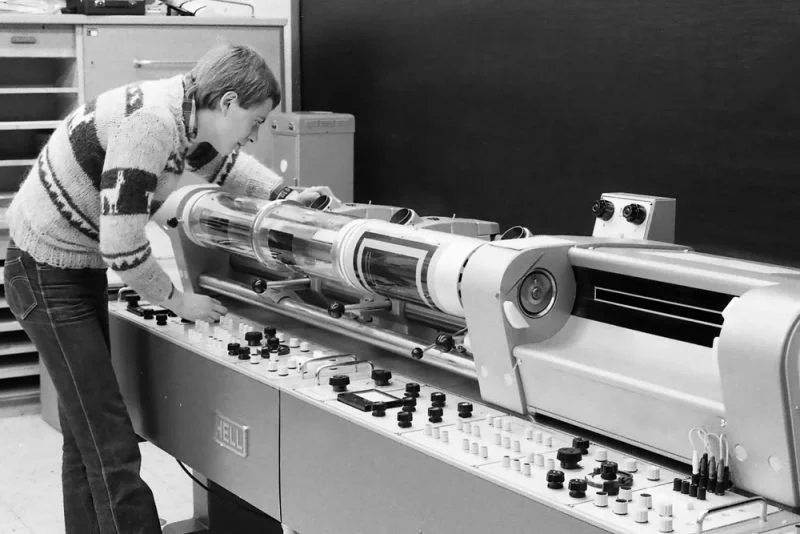
Hell Chromagraph DC-300, Source: Wikimedia Commons
At RIT, we had a couple large drum scanners in the basement of the school along with a state-of-the-art Scitex system which predated desktop alternatives such as Adobe Photoshop and Illustrator and Quark Xpress. While I was a student in the photography school, I crossed over to the printing school to take classes because I was fascinated with the process and wanted to learn how to reproduce my work to achieve the finest results. Those machines were the bedrock of the industry and yet the upheaval was already under way.
Upstairs, Professor Douglas Ford Rea was introducing students to digital photography and desktop publishing while it was all emerging. The tools were rudimentary at the time, but the change was unstoppable.
Back on the scanner front, over time, costs dropped, and RGB drum scanners expanded from commercial print and reached the wider photography market. At the same time, flatbed and CCD film scanners emerged as a challenger. It felt like a war of technologies — everything in flux, the rate of change was unrelenting. By the first decade of this century, drum scanning had peaked and today, there are no drum scanners in production. Most flatbeds for high end graphic arts are gone too, with rumors that some of the remaining units are approaching end of life. Digital photography has replaced most commercial work, and nearly all photography now follows a digital workflow.
We all know what happened to the consumer camera market and how it was eviscerated by smartphones. While film was an amazing technology, the smartphone blew past it from the perspective of quality, cost and convenience. Anyone who shot 126 film in an instamatic camera will recognize the leaps and bounds improvement in quality of consumer grade images from the film images to what a smartphone could capture. It wasn’t even close! It really seemed like film was dead.
And yet.
What I keep coming back to is a shift I noticed while working with Don Franz on a study of the film market a few years back. The client had seen an uptick in film sales and wanted to understand why. What stood out most was a change in mindset — away from technical purity and toward experience. There was a genuine rejection of digital perfection in favor of what people perceived as analog magic. One photo lab told us that customers were asking how to engineer light leaks into their cameras. I still chuckle at that.
Looking back, I realize the revival of film wasn’t happening in isolation. It coincided with the rise of what became known as the maker movement — a broad cultural return to making things by hand. I’m still amazed that there are 5.6 million sellers on Etsy — woodworkers, ceramicists, letterpress printers, bookbinders, knitters, photographers, and digital fabricators all drawn by a similar impulse. After years of technology making things faster, cheaper, and easier to reproduce, people began placing new value on process, materiality, and skill. The object mattered, but so did the experience of making it.
Photography fit naturally within that movement. For some, film became less about technical superiority and more about participation in a physical process. The loading of film, the uncertainty of exposure, the wait for development, the print itself — these became part of the meaning of the photograph. Printmaking experienced a similar revival. Whether through traditional stone lithography, letterpress, screen printing, photogravure, or fine-art inkjet printing, the print re-emerged as an object rather than merely a vehicle for an image. The maker movement didn’t create that reverence, but it provided a cultural home for it. That culture includes a community element with maker studios popping up for the community to gather and play. I recall a recent trip back to Rochester to visit the school and they have an entire building dedicated to maker studios where students can experiment with everything from letterpress to 3-D printing.
More recently, photography influencers have been talking about a rejection of AI imagery — and how that’s sending professionals back to film. The perception that digital images are so technically perfect they’re mistaken for AI has apparently become a real concern in commercial photography circles. There is a demand for authenticity. One influencer put it bluntly: professionals in New York City better have a film camera, because client requirements are changing fast.
The parallel to digital disruption isn’t lost on me. When desktop publishing arrived, it didn’t just change the tools — it eliminated entire trades. The drum scanner operators, the film strippers, the dot etchers — highly skilled craftspeople whose expertise became economically invisible almost overnight. Digital didn’t devalue their knowledge; the market simply stopped paying for it.
AI imagery feels like that moment, but faster and with a wider impact. Digital replaced the equipment. AI is replacing how we make images. For commercial photographers — the people shooting products, portraits, and perhaps editorial illustration work — the question is no longer whether AI will affect their business. It already has. Stock libraries are flooded with synthetic imagery. Ad agencies are running campaigns generated entirely without a camera. The expectation for the enhanced image is growing — from computational tools like focus stacking to AI-driven image enhancement such as noise reduction and generative fill — these are fast becoming baseline assumptions.
AI is infiltrating the industry like low resolution digital cameras did in the early 1990s. The $20,000 Kodak DCS 100 — a 1.3-megapixel sensor introduced in 1991 — was a high-end system. Compare that to today’s smartphones or even Kodak’s blind box Charmera digital cameras with 1.6 megapixels selling for $39.99, while high-end digital cameras now offer 50, 100, 150, even 250-megapixel sensors — many surpassing the capability of film.
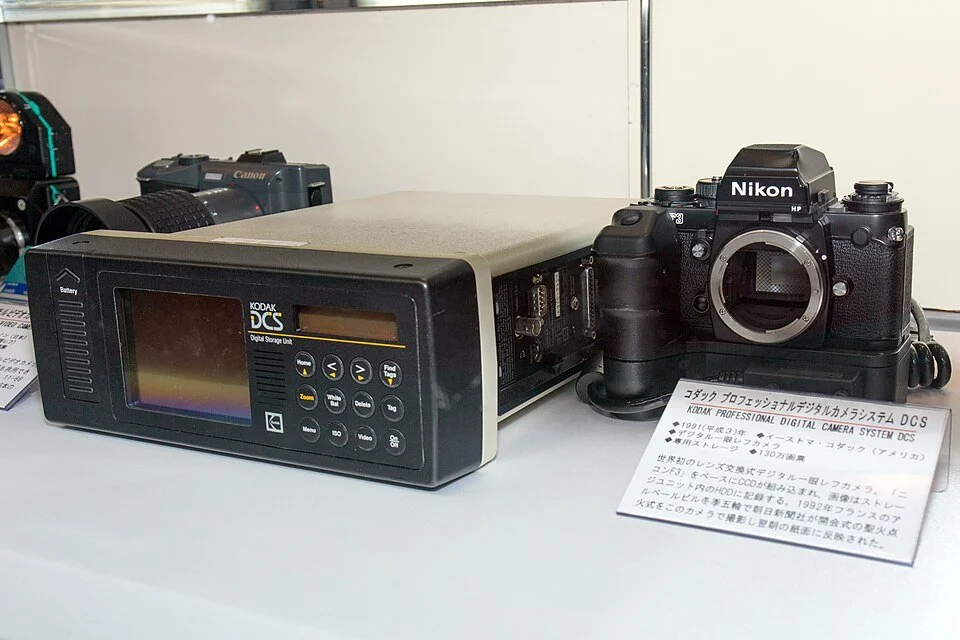
Kodak DCS 100, Source: Wikimedia Commons
Like the early digital cameras, today’s AI image generators are creating low resolution images. Artists are upscaling the images to add resolution and then blending them with digital camera content. But the parallel is not lost between the hugely disruptive digital camera revolution and transformative AI technology. The pressure on working photographers is real and accelerating … and so are the risks and opportunities.
And yet the response is familiar. Just as digital perfection is motivating some photographers back to the texture and perceived analog quality of film, AI perfection — that uncanny, frictionless polish — is creating its own countermovement. What AI cannot fake is the evidence of a human hand. The light leak someone engineered into their camera. The paper choice that took an afternoon to get right. The hours behind a single print.
These aren’t inefficiencies. They’re evidence.
What strikes me is that the countermovement isn't a rejection of technology. The fine art printer obsessing over paper is using state-of-the-art equipment. The commercial printer chasing expanded color gamut, digital embellishment, and wider substrate capabilities is pushing the science further than ever. The tools have never been more capable. What's changed is the intention behind them. Craft values — reverence for materials, attention to process, commitment to quality — are reasserting themselves inside the technology, not against it. In a world where success is measured in likes, authenticity differentiates. It stands out. The spirit of art didn't disappear during the long march toward efficiency. It just went quiet for a while. It's back.
In a landscape saturated with generated imagery, proof of human presence in the work is becoming its own kind of value. At its core, the rejection of AI imagery — like the rejection of digital before it — is a search for authenticity. For the experience of making and holding something real. Most will embrace these new tools; others won’t. But the toolkit has expanded — and clearly, we are on another precipice of significant change.
I was at the forefront of digital adoption and was all too eager to leave film behind — accelerated, in part, by developing a skin sensitivity to metol, a component in one of the darkroom developers. No more darkroom for me. Digital photography was more efficient, offered more control, and greatly expanded creative editing … and it was exciting!
My workflow today is entirely digital, and I’ve made peace with that — more than peace, actually. I shoot with a high-resolution Sony camera, rely on state-of-the-art color management, and print on an Epson inkjet. But what connects me to those darkroom hours isn’t the technology. It’s the intention. I’ll spend hours adjusting an image, pulling test prints, evaluating, correcting, and printing again. The tools have changed completely. The reverence hasn’t.
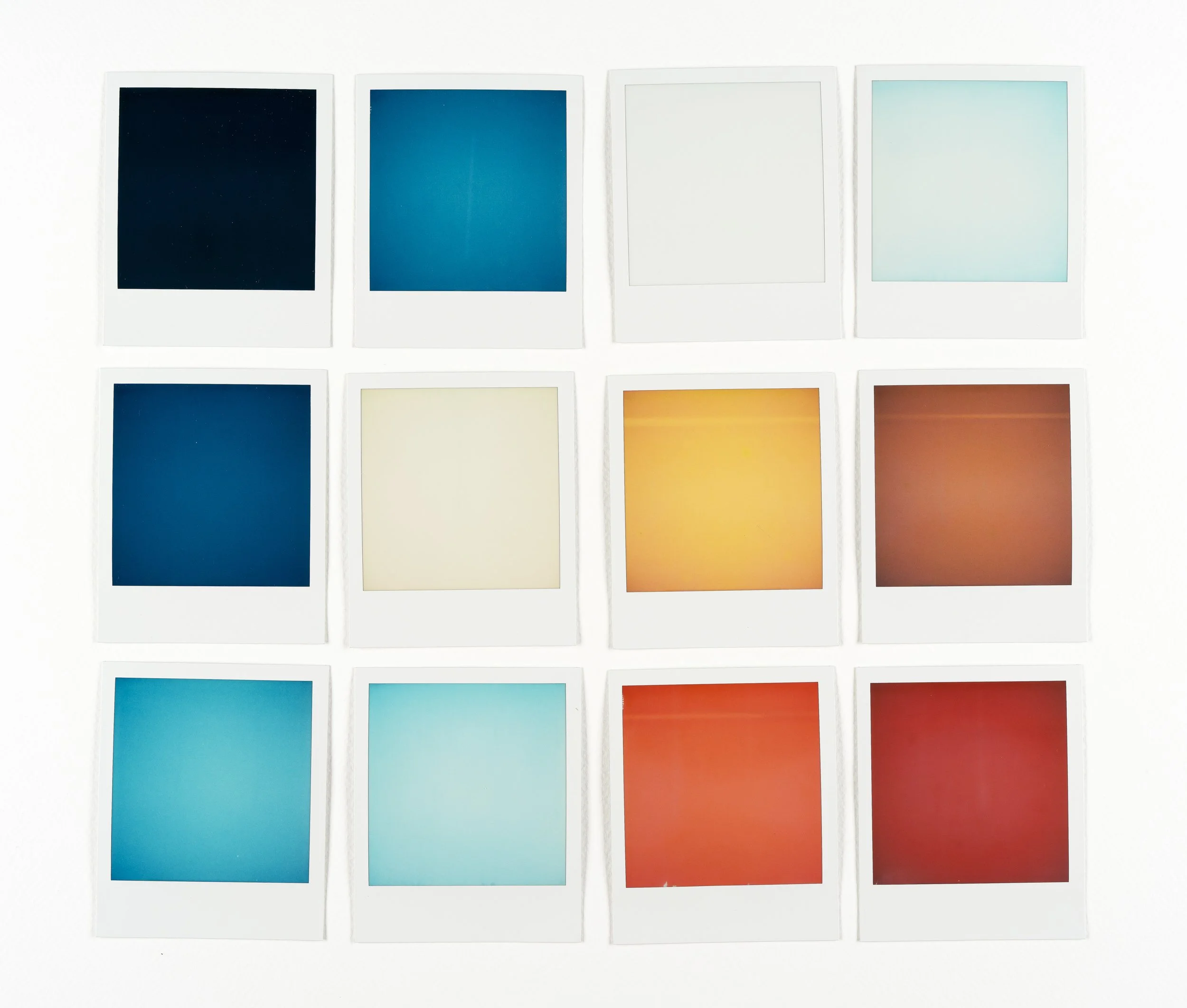
Chromatic Equivalents #1
The print is where much of that reverence lives now. I spend real time exploring paper samples — weight, texture, coating, tone — because the substrate is never neutral. The paper is part of the image. A print on a warm cotton rag says something different than the same image on a cool baryta surface and getting that relationship right matters to me the way a perfect fiber print once mattered in the darkroom.
What strikes me now is that photographers and printmakers are often searching for the same thing. Both disciplines ultimately transform an idea into a physical object. The negative, the plate, the screen, the file — these are all intermediate steps. The print is where the work becomes real. Perhaps that’s why so many photographers eventually become obsessed with paper and the final print. They discover that photography is not only about seeing. It is also about making.
What gives me genuine optimism is that I’m not alone in this. A renaissance seems to be underway — not a nostalgic retreat, but something more interesting: a growing community of photographers, both film and digital, who care deeply about the experience of making and holding a photograph, a zine, or a book. After decades of chasing speed, convenience, and resolution, something is pulling us back toward slowness, intention, and the physical object. Film shooters engineering light leaks. Fine art printers obsessing over paper. I find it fitting that my own recent work has brought me here too — incorporating typewriters, Polaroid prints, encaustic wax, cyanotypes, and watercolor paper as the object itself.
The maker movement revealed something the digital revolution had obscured: people don’t only value the thing that is made. They value participation in the making.
It turns out the reverence never left. It just needed somewhere to go.