
The Arc of Reckoning
Evidence, Accountability, and the Search for Truth
Since 2019, I’ve been building a series of images in response to political change and the impulses towards illiberalism. I’ve focused the work to be more about human nature and political conflict that can stay legible regardless of time or place. Over time, I’ve come to understand this series as an Arc of Reckoning.
This series is not an examination of one political ideology or one group of people. It is an exploration of the human tendencies that emerge when truth becomes contested — the desire to believe, the willingness to dismiss, the impulse to defend, and the difficulty of looking honestly at ourselves. The work examines how these forces shape our collective reality and ultimately asks what responsibility we each carry in creating the world we inhabit.
At the core of this series is an exploration of repetition — not as redundancy, but as a way of creating space for experience and reflection. The repeated actions within each work are intentional. They slow the process down, allowing us time to sit with difficult ideas rather than quickly move past them.
The images are not intended to be understood only as objects to observe. The image is not the destination; it is the point of entry. Each work is a trigger — an invitation to go deeper into memory, perception, and emotion. Through repetition, the work creates a space where trauma can be acknowledged, but also where mindfulness, acceptance, and the possibility of change can begin. The goal is not simply to present an image, but to create an experience: one that encourages the viewer to stay longer, reflect deeper, and perhaps recognize something within themselves that may lead to transformation.
Fact Fake — Perception
Fact Fake explores the Illusory Truth Effect and how repetition erodes the line between truth and lies. It marks the beginning of the arc, examining the instability of perception — the moment when certainty begins to fracture.
Typed on a 1930s Royal 10 typewriter during the 2019 impeachment hearings, the words fact and fake are repeatedly corrected with white-out until the correction becomes indistinguishable from the damage, making fact and fake nearly impossible to tell apart.
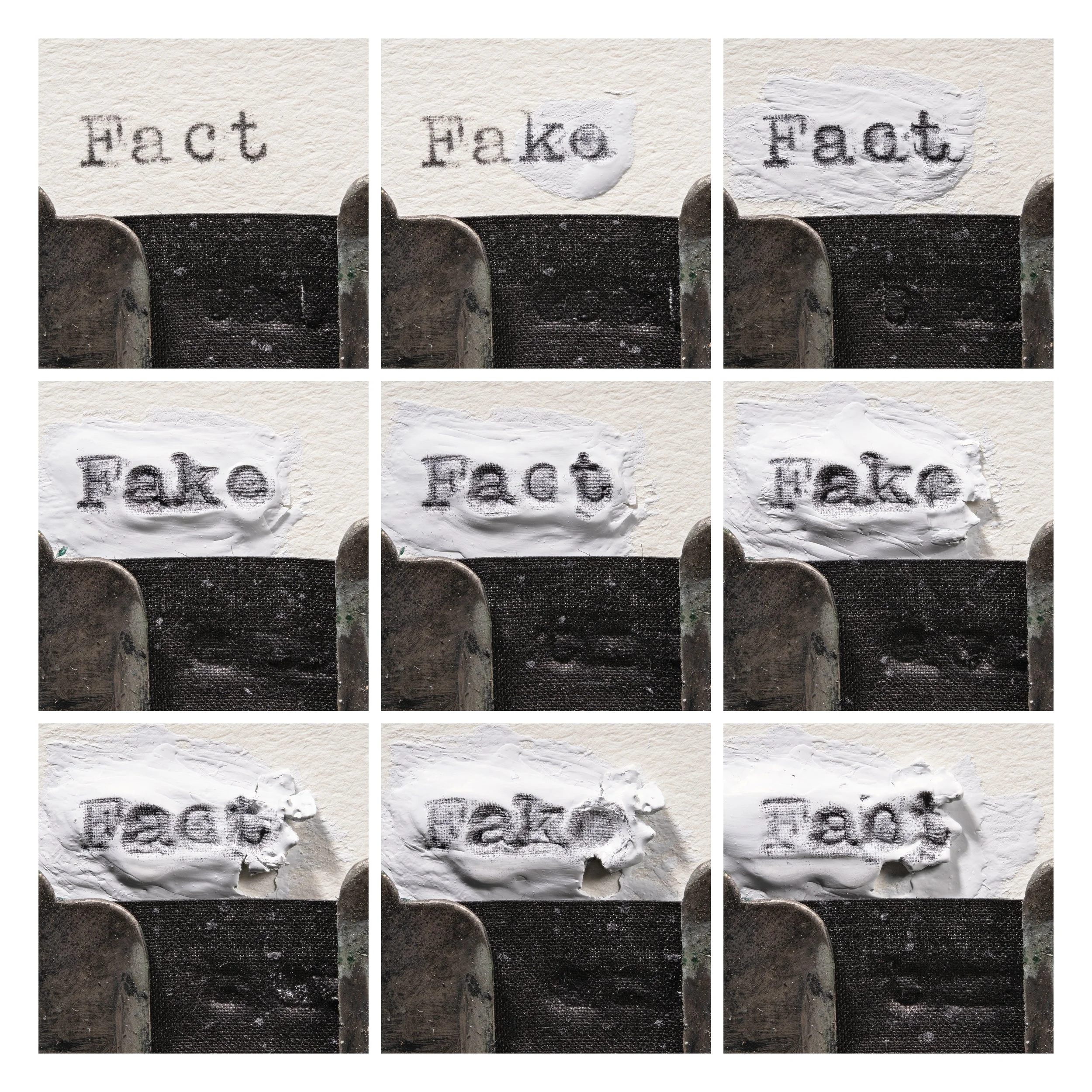
Fact Fake
Erasure — Loss
Erasure is about witnessing and documenting what is lost rather than confronting it head on. Through repetition and removal, it examines the residue left behind when something is systematically diminished or forgotten.
Graphite is sanded on and rubbed off, again and again, leaving only stains and damage — a quiet, cumulative violence enacted through repetition.
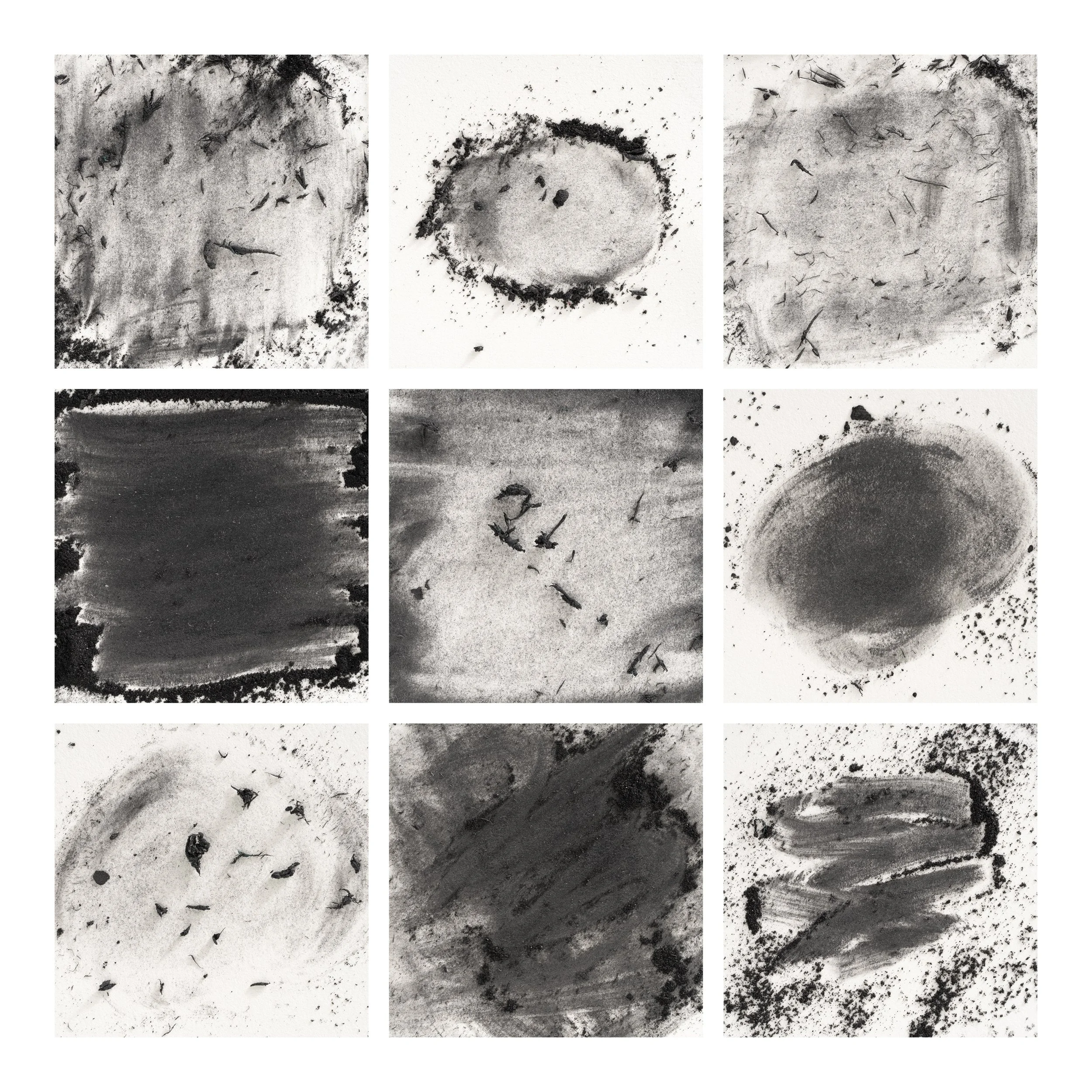
Erasure
Broken — Rupture
Broken addresses the moment when systems, structures, or assumptions fracture beyond easy repair. Cyanotype captures the memory of shattered glass rather than the glass itself, presenting the condition of an irreversible political moment without proposing an order to it.
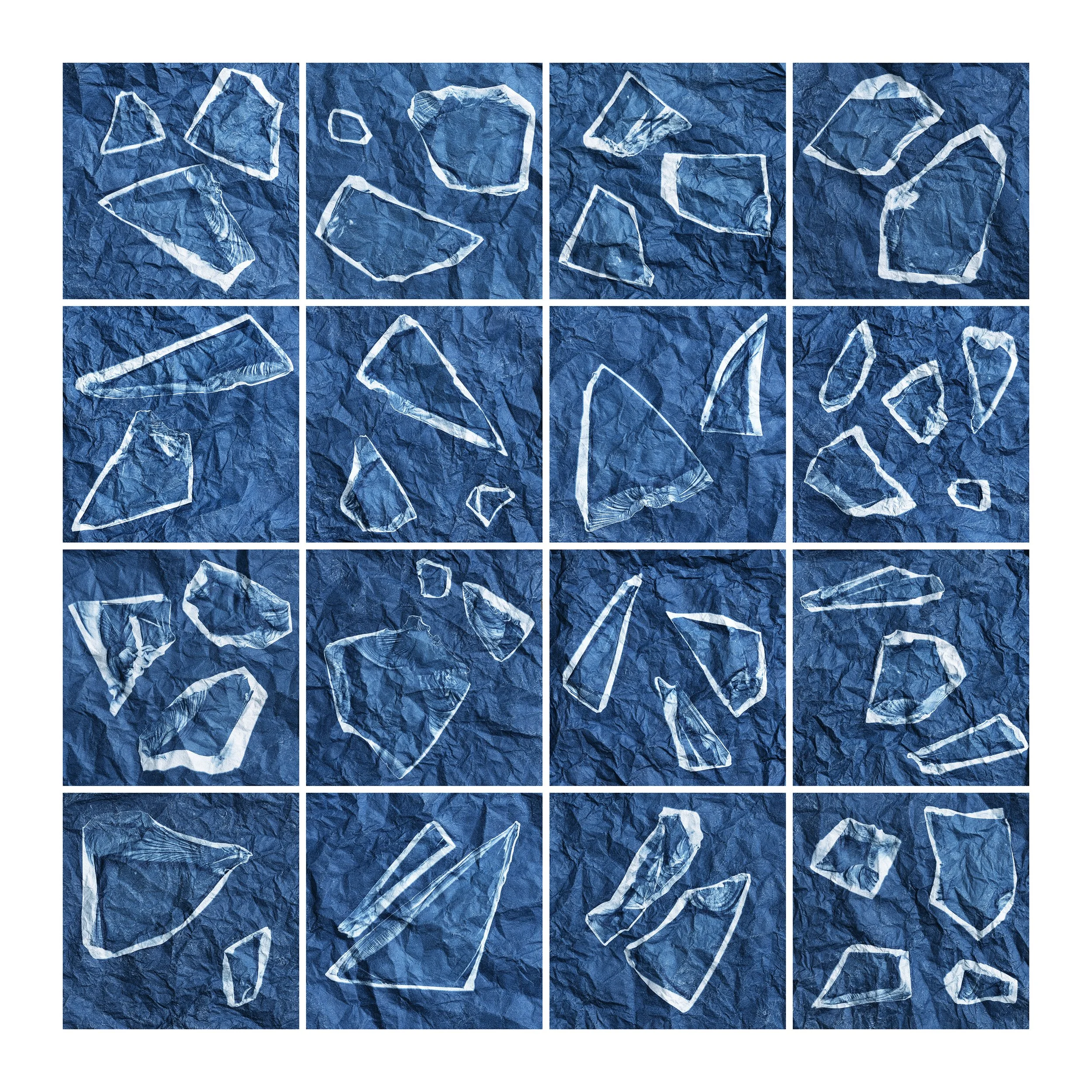
Broken
The Cost of Lies — Confrontation
The Cost of Lies explores confrontation — the exhausting effort to correct falsehoods and the realization that opposition, even when necessary, does not fully restore what was damaged.
The word lies is printed, buried beneath wax, and carved at again and again — a necessary opposition that never fully erases what it is fighting and leaves its own scar in the process.
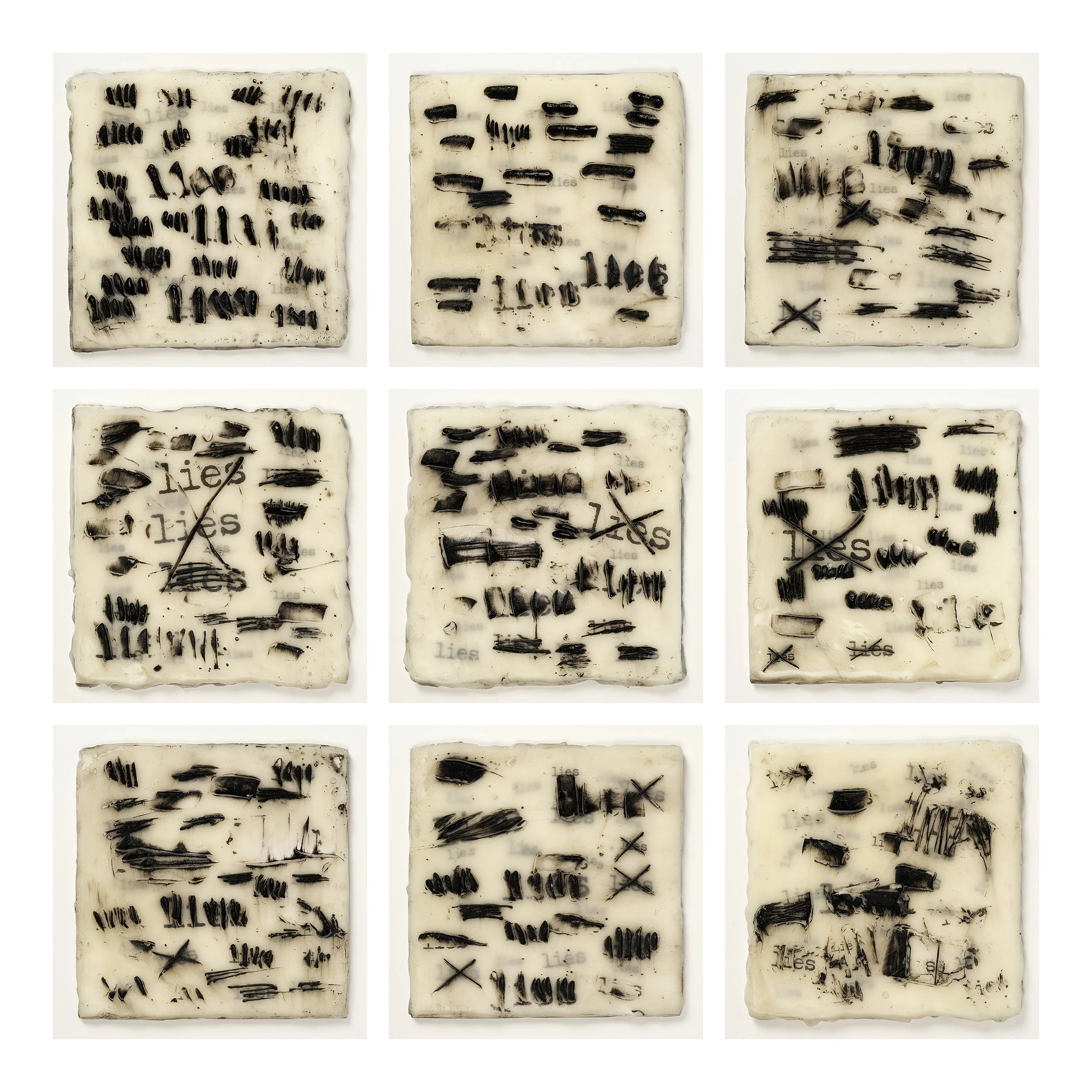
The Cost of Lies
Reconcile — Evidence & Accountability
Reconcile represents the next step in the arc: the search for what remains. It moves from witnessing and confrontation toward evidence, acknowledgment, and ultimately accountability. Through excavation and reconstruction, evidence becomes the foundation for understanding what has been concealed.
Reconcile treats data as evidence to be uncovered — sifted, cut, and removed until what remains reveals the picture. I choose binary code because it is a fundamental element of information. I worked with letterpress printing to imprint the digits into heavy cotton rag paper.
As a metaphor, the paper holds the digits like a rock holds a fossil. It is there, permanent, but it must be found through patience and careful excavation.
Archaeology is not about creating something new; it is about uncovering what has always existed beneath the surface. The archaeologist does not impose a story onto the artifact, but carefully removes what obscures it, allowing meaning to emerge through context and connection.
In the same way, Reconcile is not about creating a new truth, but recovering what was already there.
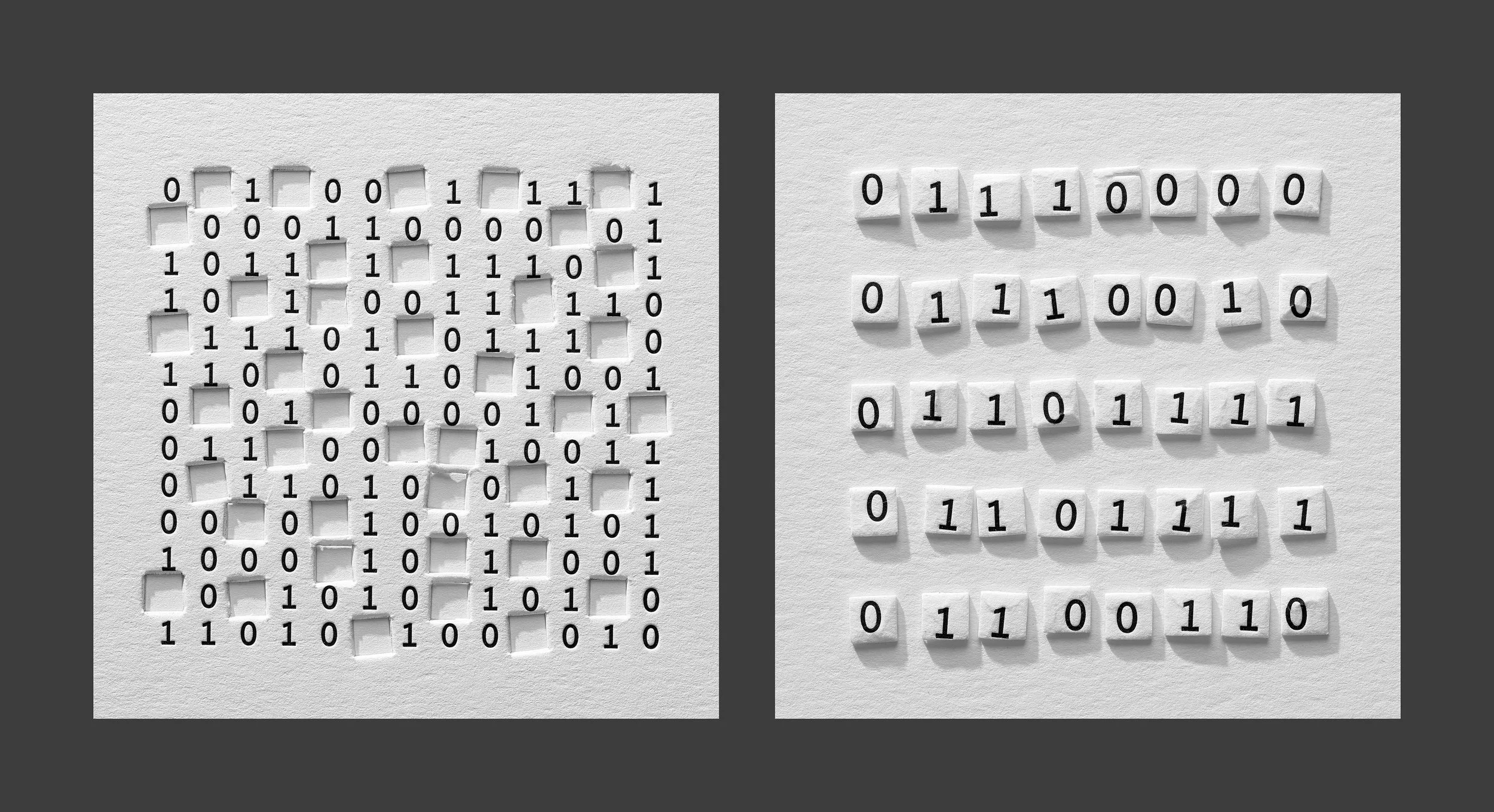
Reconcile
On the left, a field of digits makes a statement that may never be fully decoded. But the process of starting is what this work is about. Each digit is a fragment, extracted by force, the paper resisting the release like a system resisting accountability. What was scattered in chaos begins to take shape. Like an archaeological site, the fragments alone may appear meaningless, but together they begin to reveal a buried record.
On the right, those same fragments are reassembled to spell the word proof. I chose the word for its legal connotation and its relationship to truth and reconciliation. But proof speaks to evidence without moving to judgment. It is literally the reconciliation of data — fragments brought together to reveal what was already there.
Both panels were photographed flat, so the physical act of extraction and assembly becomes its own kind of document. On the technical side, lighting was key to reveal the texture and subtle relief of the paper. This created challenges given it’s a white-on-white, high-key image, which often pushed highlights into darker shades of gray. I photographed this work many times to get it just right.
Reconcile does not suggest that accountability is simple or that every fragment can be recovered. It suggests that the work begins with the willingness to look — to excavate, to interpret, and to confront what has been buried.
Art is a journey of discovery, and that’s how this series has developed. The Arc of Reckoning has emerged over time, moving through perception, loss, rupture, confrontation, and accountability. But it does not end there. The work continues toward questions of how truth itself can become distorted — a post-truth condition in which the distinction between what is true and what is believed becomes increasingly difficult to hold — and, ultimately, toward the recognition that meaningful change requires us to look inward.